.png?2026-03-07T03%3A39%3A27.208Z)
Measuring
The Big Tree Formula
Each tree nominated to the PA Champion Tree Program is assigned a point value. The tree with the most points for each species is the Champion! The Big Three Program takes into account three measurements:
Circumference in INCHES: 1 point for every 1 inch trunk circumference +
Height in FEET: 1 point for every 1 foot of tree height +
Spread in FEET: 1 point for every 4 feet of canopy spread =
TOTAL BIG TREE POINTS
To measure a prospective champion, you will need some basic tools. Below, you will find the accepted methods for measuring trees. All measurements will be accepted, but they will need to be verified before champion status will be given. The latest measuring techniques can be found at the American Forests website.
.jpg?2026-06-04T15%3A23%3A04.534Z)
Circumference
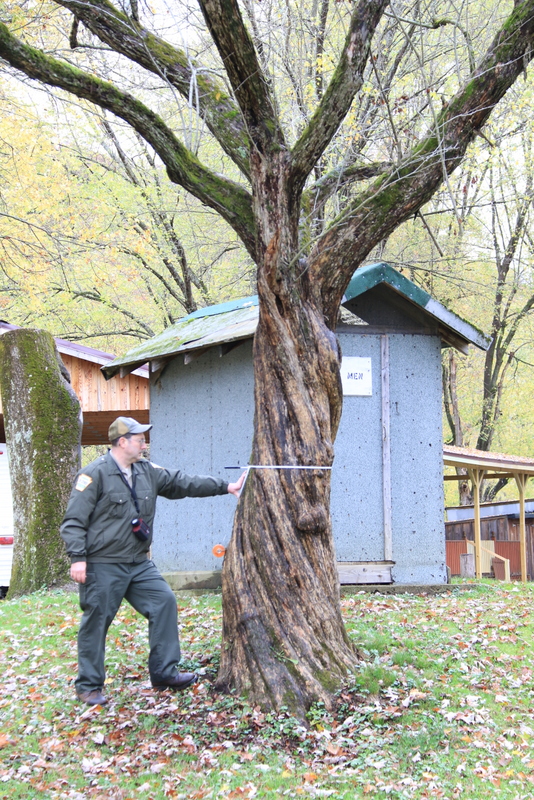
The first measurement to take is Circumference at Breast Height (CBH).
Measure CBH in INCHES at 4.5' above the ground (this is the standard measure of "breast height" used by foresters nationwide)
-If the tree is growing on a slope, measure 4.5' from the ground at MID-SLOPE, halfway between the highest and lowest points where the trunk meets the soil
-If the tree has a single stem (one pith at ground level), but branches below 4.5' or has an abnormal swelling or burl, measure CBH at the narrowest point below 4.5', and note the height measured.
-If the tree has multiple stems (several separate piths at ground level), measure CBH of the LARGEST stem at 4.5', or above where the stems are conjoined
Each tree gets 1 BIG TREE POINT for every INCH of circumference.
Height
The Height of a tree is measured is the distance in FEET measured from the point where the tree emerges from the ground (at mid-slope if the tree grows on a slope) to the tallest living part of the tree.
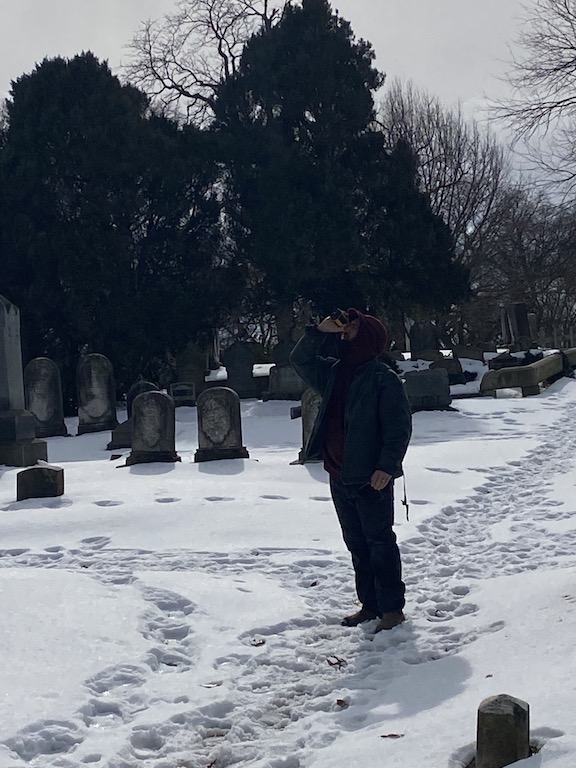
The most accurate way to measure the height of a tree is with a specialized tool called a LASER RANGEFINDER. This is recognized by the Eastern Native Tree Society (ENTS) as the preferred method for height measurement (see link below). This tool allows the user to simply stand at a point away from the tree where the very top and bottom of the tree are visible, and take a laser measurement of each point. The rangefinder calculates the distance and the angle of incident and gives an accurate height. Our foresters and volunteers use this method.
Other ways of measuring tree height include using a Clinometer at 100' distance, Abney Level, or other non-technical techniques such as the "stick method" (see link and image below).
Height is often the measurement that is calculated incorrectly. The most common errors come from not being able to see the top of the tree, mistaking the visible edge of the canopy as the top, and the top not being directly over the base of the tree
If height cannot be measured accurately by technical means, nominators are encouraged to estimate height using nearby known objects (such as a home). Height measurements can then be verified by a certified forester or trained volunteer.
Each tree receives 1 BIG TREE POINT for every FOOT OF HEIGHT
Spread
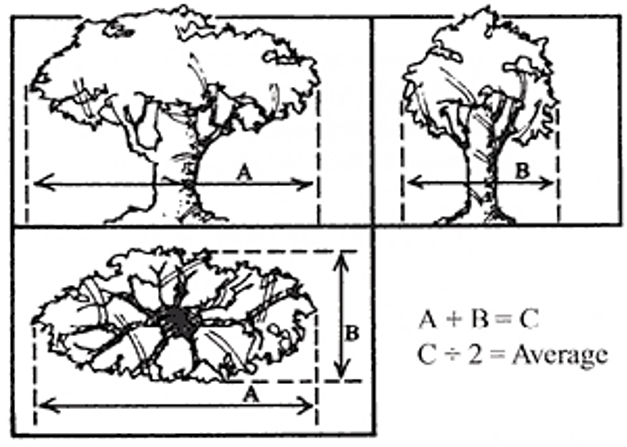
Canopy Spread is a horizontal measurement, from leaf tip to leaf tip, of the extent of a tree’s canopy. This measurement is relatively easy to take with a long tape measure and a friend. Simply stand at one end of the canopy at the furthest end of a living branch, and have your friend extend the measuring tape to the other furthers living branch in a straight line.
Because tree canopies are not perfect circles, it is important to get TWO measurements of Spread taken PERPENDICULAR to each other if possible. These two spreads are averaged, and that AVERAGE SPREAD is considered for estimating a point value. of the shortest spread, and the longest spread of the tree. Adding the two numbers together, and then dividing by two will give you the average crown spread.
Each tree gets 1 BIG TREE POINT for every 4 FEET of Average Canopy Spread. (Each FOOT of Average Canopy Spread adds ¼ POINT to the BIG TREE SCORE)